Tummy Tuckin Fort Lauderdale

Abdominoplasty by double board-certified plastic surgeon Dr. Nathan Eberle. Excess skin removed, weakened muscles repaired, and a flatter, firmer abdomen.

What Is a Tummy Tuck?

A tummy tuck, known medically as abdominoplasty, flattens and firms the abdomen. It is the operation for the problems diet and exercise cannot reach: loose, hanging skin does not shrink back at the gym, and separated abdominal muscles do not knit themselves back together with core work.

Tummy tuck surgery by double board-certified plastic surgeon Nathan Eberle, M.D., D.D.S., F.A.C.S., serves patients from Fort Lauderdale and across Broward County at Weston Center for Plastic Surgery, a short drive from anywhere in South Florida.

One Operation, Three Layers

What separates abdominoplasty from every other body procedure: it addresses all three layers of the abdomen in a single surgery. Select a layer to see what happens to it.

Particle light artwork of a woman's torso with a sheer veil of light drawn smooth over the abdomen

Loose, stretched skin is drawn smooth and the excess is removed. Stretch marks on the skin that is removed go with it.

Particle light artwork of a woman's torso with clouds of particles lifting away from the waist

Stubborn abdominal fat is removed directly and, in many surgical plans, refined with liposuction of the waist and flanks for a smoother contour.

Particle light artwork of a woman's torso with two bands of light laced together along the midline

When pregnancy or weight change has separated the abdominal muscles, a condition called diastasis recti, plication sutures draw the abdominal wall back together, flattening the bulge that sit-ups cannot fix.

Tummy Tuck Before & After

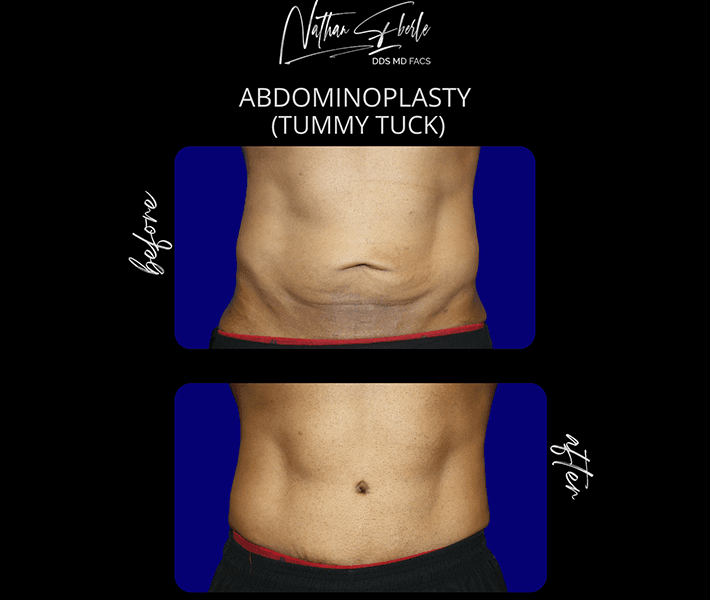
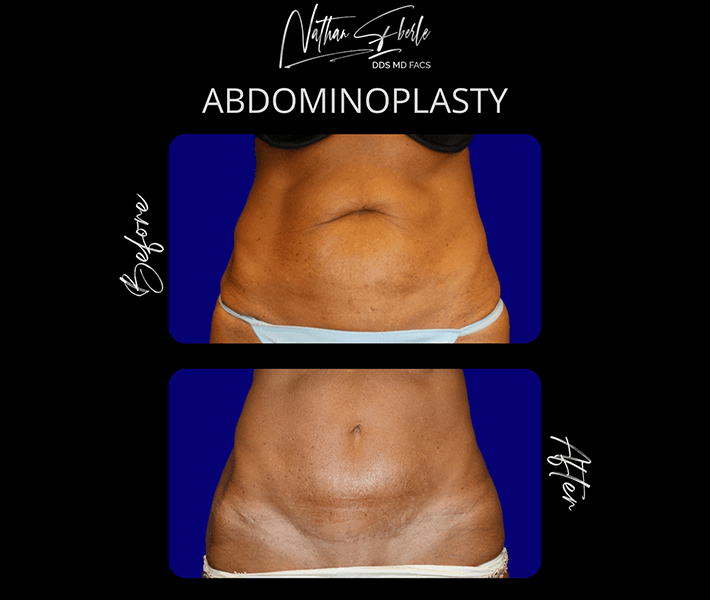
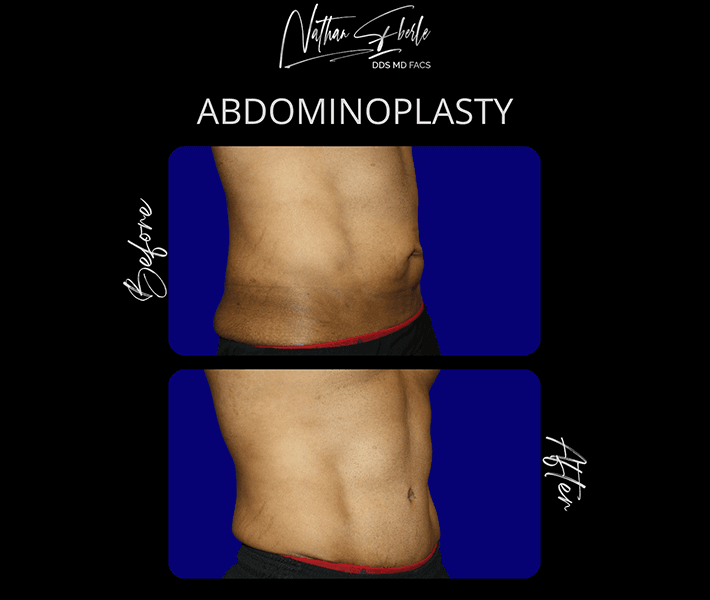
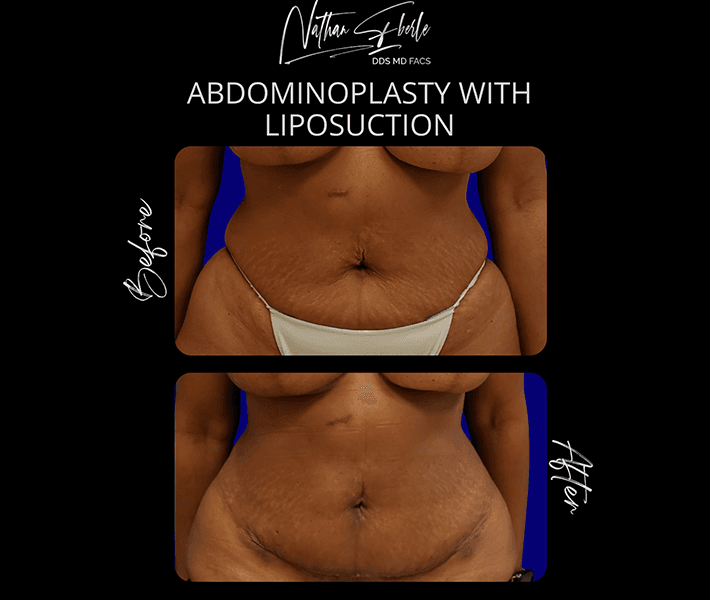
The clearest way to judge tummy tuck results is to look at them. Browse 50 real cases performed by Dr. Eberle, each photographed before surgery and after recovery.

View Full Gallery
Tummy tuck before-and-after photographs, case 2
Full tummy tuck with abdominal wall plication.
Tummy tuck before-and-after photographs, case 4
Drainless Tubeless Tuck technique.
Tummy tuck before-and-after photographs, case 6
Excess skin reduction and waistline contouring.
Tummy tuck before-and-after photographs, case 13
Abdominoplasty combined with liposuction.

Actual patients of Dr. Eberle. Individual results may vary.

The Tubeless Tuck: a Drainless Recovery

For appropriate candidates, Dr. Eberle replaces the closed suction drains of a traditional tummy tuck with dissolvable internal sutures that close the space where fluid would otherwise collect. The difference shows up in what your first 2 weeks look like.

With drains

The Tubeless Tuck

External tubes

Attached at each hip for up to 2 weeks

None

Daily routine

Empty and measure output 2 to 4 times a day

Nothing to empty or record

At the skin

Tubing pulls where it exits, often leaving small extra scars

No drain-site openings at all

How the space closes

Drains pull fluid out while the tissue slowly seals

Dissolvable internal sutures close it during surgery

Fluid buildup after a tummy tuck can form a seroma, which sometimes requires drainage and further treatment. Whether the drainless technique fits your surgical plan is decided with Dr. Eberle at consultation.

Woman drawn in particle light standing at the ocean shoreline at dawn, calm water stretching to the horizon

Full, Mini, or Liposuction?

Start from what is actually causing the shape you see. Skin, fat, muscle, or all three: the answer picks the procedure.

Loose skin above the navel, separated muscles, or a whole abdomen that needs reshaping.

Full Tummy Tuck

A hip-to-hip incision treats the entire abdomen: skin and fat above and below the navel, muscle repair when indicated, and a repositioned belly button.

A small, stubborn pouch confined to below the navel.

Mini Tummy Tuck

A shorter incision and a smaller surgery limited to the lower abdomen. The belly button stays untouched and recovery is typically easier.

Explore Mini Tummy Tuck

Smooth, elastic skin where fat is the only concern.

Liposuction Alone

Removes fatty tissue through much smaller incisions, but cannot remove loose skin or tighten muscle. Often combined with a tummy tuck rather than replacing it.

Explore Liposuction

Many women pair a tummy tuck with breast surgery as part of a mommy makeover in Fort Lauderdale, restoring the abdomen and breasts in a single recovery. Still weighing the tuck against liposuction? We compare the two in Liposuction vs. Tummy Tuck.

In the Operating Room

A tummy tuck is major abdominal surgery, and it follows a deliberate sequence.

  1. General anesthesia

    You are asleep for all of it, typically 2 to 3.5 hours.

  2. The incision

    Low across the abdomen, hip to hip, placed where underwear or a swimsuit bottom covers it.

  3. Muscle repair

    When indicated, plication sutures draw the separated abdominal wall back together at the midline.

  4. Skin and fat

    Excess is trimmed away and the remaining tissues are drawn smooth and contoured.

  5. The navel

    Brought out through a new opening in its natural position and reshaped.

  6. EXPAREL and closure

    A long-acting, non-narcotic local anesthetic is placed before you wake, intended to carry you through the first 2 to 3 days.

Anesthesia
General
Time
2 to 3.5 hours in the operating room
Setting
Certified in-office operating room, outpatient surgery center, or hospital; overnight stay optional in appropriate cases
At home
Lower-extremity compression devices for home use and a scar recovery program
Diagram comparing tummy tuck incisions: a full tummy tuck incision running hip to hip below the navel, and a shorter mini tummy tuck incision low on the abdomen
Incision length compared: full tummy tuck at left, mini at right.

The Scar, the Belly Button, and Healing

An informed decision is a durable one. These are the physical trade-offs Dr. Eberle walks every tummy tuck patient through before surgery.

The Scar

A full tummy tuck leaves a permanent scar running low across the abdomen from hip to hip, placed so underwear or a swimsuit bottom covers it. It typically fades and flattens considerably through the first year, and the practice's scar recovery program supports that process from the first follow-up visit.

The Belly Button

Because the skin of the abdomen is redraped, the navel is brought out through a new opening in its natural position and reshaped. The goal is a belly button that looks like it was never touched.

Sensation and Swelling

Temporary numbness of the lower abdomen is common while nerves recover, and swelling settles gradually over several months. It can take up to 3 months to feel completely healed.

The Classic Candidate

Tummy tuck patients tend to share a profile. See how much of it is yours.

A checklist is not a diagnosis. Candidacy is decided in person, with your anatomy and health history in the room.

When It Is Smarter to Wait

Another pregnancy is planned

Pregnancy can stretch the repaired abdominal wall and skin, undoing much of what surgery accomplished.

Weight is still moving

A tummy tuck performed at a stable weight lasts. One performed mid-journey may not.

Smoking

Smoking interferes with healing. Patients stop before and after surgery on the timeline Dr. Eberle sets.

None of these are permanent disqualifiers. They are reasons to time the operation so the result is worth keeping.

What Is Tummy Tuck Recovery Really Like?

Recovery unfolds over weeks, not days. We walk through the full arc in The Tummy Tuck Recovery Process.

Woman drawn in particle light resting on her side on soft pillows during the first week of tummy tuck recovery

Week 1

Rest comes first. EXPAREL carries the first 2 to 3 days, a compression garment goes on right away, and lower-extremity compression devices come home with you.

Woman drawn in particle light walking gently with a hand over her abdomen in the weeks after tummy tuck surgery

Weeks 2 to 6

Soreness, bruising, and tightness fade week over week. Most patients are back at desk work within 2 to 3 weeks; exercise waits for clearance.

Woman drawn in particle light standing tall with arms stretched wide, fully recovered after tummy tuck surgery

Months 2 to 12

Full exercise resumes around 6 weeks for patients whose muscles were repaired. Swelling settles over months, and the scar fades and flattens through the year.

The Risks, Plainly Stated

A tummy tuck is a significant operation, and an honest decision accounts for its risks: bleeding, infection, delayed wound healing, fluid accumulation, asymmetry, changes in skin sensation, and the risks that accompany general anesthesia. Dr. Eberle reviews your health history and walks through each of these with you in person before you decide.

Two limits are worth naming plainly. A tummy tuck is not a weight-loss operation, and it cannot remove the internal fat that surrounds the organs. And while the skin and fat removed are gone permanently, a future pregnancy or a significant weight swing can stretch what remains. Weighing both sides? We lay them out in The Pros and Cons of Getting a Tummy Tuck.

What Shapes Your Quote

No two tummy tucks are the same operation, so no two carry the same price. Six variables set the number, and you receive a personalized quote after Dr. Eberle has examined you and built your surgical plan.

Scope of skin removal
How much loose tissue comes away
Muscle repair
Whether plication is part of the plan
Liposuction
Contouring combined with the tuck, or a second procedure
Surgical setting
In-office operating room, surgery center, or hospital
Anesthesia
General, with an anesthesia provider
Postoperative care
Garments, compression devices, and follow-up included

Weston Center for Plastic Surgery is a self-pay practice and does not accept medical or dental insurance. Patients seeking reimbursement from their own insurer submit their own claims.

Why Have Your Tummy Tuck with Dr. Eberle?

Dr. Nathan Eberle, double board-certified plastic surgeon

Dr. Nathan Eberle, M.D., D.D.S., F.A.C.S., is a double board-certified plastic surgeon and oral and maxillofacial surgeon with more than 15 years of surgical experience. He completed his plastic and reconstructive surgery residency at Cleveland Clinic Florida, here in Weston, and is a Fellow of the American College of Surgeons.

Abdominoplasty is a procedure where surgical judgment shows: how much skin can safely be removed, whether the muscles need repair, and how to place a scar so clothing hides it. The same team cares for you from consultation through follow-up. Learn more about Dr. Eberle or tour the surgical center.

Tummy Tuck FAQ

Straight answers to the questions patients ask most before deciding on a tummy tuck.

The cost of a tummy tuck depends on the scope of skin removal, whether the abdominal muscles are repaired, whether liposuction or another procedure is combined with the surgery, the surgical setting, anesthesia, and the postoperative care included in your plan. Because every abdominoplasty is tailored to the patient, Weston Center for Plastic Surgery provides a personalized quote after your consultation with Dr. Eberle. Financing through CareCredit, Cherry, and PatientFi is available.

No. Weston Center for Plastic Surgery operates on a self-pay basis and does not accept medical or dental insurance. Patients who wish to pursue reimbursement from their own insurance provider are responsible for submitting and managing their own claims. Financing options are available to help spread out the cost of surgery.

A full tummy tuck addresses the entire abdomen. The incision runs low across the abdomen from hip to hip, excess skin and fat are removed above and below the navel, the abdominal muscles can be repaired, and the belly button is repositioned. A mini tummy tuck uses a shorter incision and treats only the area below the navel, so the belly button is usually left untouched. Patients with looseness limited to the lower abdomen may be candidates for the mini version; patients with skin excess or muscle separation above the navel usually need the full procedure. Dr. Eberle will recommend the right approach at your consultation.

Liposuction removes fatty tissue through small incisions, but it does not remove loose skin or tighten the abdominal wall. A tummy tuck removes excess skin, can repair separated abdominal muscles, and often includes liposuction for contouring. If your skin is smooth and tight and fat is the only concern, liposuction alone may be enough. If you have loose, hanging skin or a bulge that no workout improves, a tummy tuck is usually the more effective operation.

The Tubeless Tuck is Dr. Eberle's drainless tummy tuck technique, offered to appropriate candidates. Instead of external suction drains, dissolvable internal sutures close the space beneath the skin where fluid would otherwise collect. That means no tubes to empty and record at home, no drain sites to care for, and no drain-related pulling at the incision during the first weeks of recovery.

A full tummy tuck leaves a scar that runs low across the abdomen from hip to hip, placed so underwear or a swimsuit bottom covers it. The scar is permanent, but it typically fades and flattens considerably over the first year of healing, and the practice's scar recovery program supports that process. Most patients consider the trade well worth it for a flatter, firmer abdomen.

During a full tummy tuck, the skin of the abdomen is redraped, so the navel is brought out through a new opening in its natural position and reshaped. The goal is a belly button that looks natural and sits where it should on the newly flattened abdomen. In a mini tummy tuck, the belly button is usually left untouched.

Most patients return to desk work within 2 to 3 weeks. Strenuous exercise and heavy lifting wait until about 6 weeks, particularly when the abdominal muscles are repaired, and Dr. Eberle clears each patient individually. Swelling continues to settle for several months, and the scar matures over the first year.

Yes, in most cases. A future pregnancy can stretch the repaired abdominal wall and skin, and significant weight swings can compromise the result. Ideal candidates are at a stable weight they can maintain and are finished having children. If you are still planning either, Dr. Eberle can help you think through timing at your consultation.

The skin and fat removed during a tummy tuck are permanently removed, and a repaired abdominal wall does not undo itself with normal living. Results are long-lasting for patients who maintain a stable weight. Significant weight changes, pregnancy, and natural aging can stretch the remaining tissue over time.

Dr. Eberle performs tummy tuck surgery in a certified in-office operating room, an outpatient surgery center, or a hospital, depending on the surgical plan and your health history. Most patients go home the same day from an ambulatory setting, and an overnight hospital stay is an option in appropriate cases. The practice is located in Weston, Florida, serving patients from Fort Lauderdale and across Broward County.

What Should I Do Next?

Start with the before and after gallery, then book a consultation with Dr. Eberle to talk through your anatomy, your goals, and the surgical plan that fits both. If you like to prepare ahead, Your Checklist for a Better Tummy Tuck covers how to get ready.

Our Procedures

Discover the full range of surgical and non-surgical treatments tailored to your goals.